


Direct lending is not a “beta” asset.
Performance dispersion can be wide and manager selection matters.
Performance differences across direct lending managers can be material—and durable. The gap between top- and bottom-quartile returns can reach roughly ten percentage points annually, driven largely by differences in loss rates.
That dispersion isn’t random—and it persists: Managers that outperform in one period have shown a strong tendency to remain top performers in the next, while weaker managers tend to continue to underperform.
We believe that persistence reflects meaningful and sustainable differences in manager capabilities. In direct lending, success depends less on chasing market-driven income yield and more on avoiding idiosyncratic credit losses—the real source of manager alpha in private credit. Managers with stronger origination, underwriting and workout capabilities are better positioned to minimize losses. These advantages are difficult to replicate and can contribute to persistent performance differences over time.
Performance Persistence of Top and Bottom Quartile Managers
Annualized Five-Year Total Return
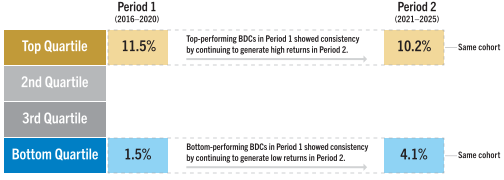
Source: Golub Capital internal analysis utilizing data provided by KBW Research. Utilizes KBW’s BDC research database of tracked return performance data covering the 10-year period from Q1 2016–Q4 2025. BDC total return is calculated as the BDC’s change in NAV per share plus total dividends per share received over the period divided by beginning period NAV per share. Performance Period 1 is the five-year period from Q1 2016–Q4 2020, and performance Period 2 is the five-year period from Q1 2021–Q4 2025. The data set excludes internally managed BDCs and BDCs with 25% or more equity investment exposure. In total, three BDCs were excluded. The data set in the chart totals 26 BDCs. Past performance does not guarantee future results.
To go deeper on this topic, read our white paper, Dispersion & Persistence of Manager Performance in Direct Lending.
Explore Other Topics
WHAT YOU’VE HEARD
Rising unrealized losses can signal credit problems that could ultimately lead to permanent losses.
WHAT YOU’VE HEARD
AI disruption in the software sector could lead to significant losses for private credit portfolios.
Disclaimer
In this document, the terms “Golub Capital” and “Firm” (and, in responses to questions that ask about the management company, general partner or variants thereof, the terms “Management Company” and “General Partner”) refer, collectively, to the activities and operations of Golub Capital LLC, GC Advisors LLC (“GC Advisors”), GC OPAL Advisors LLC (“GC OPAL Advisors”) and their respective affiliates or associated investment funds. Certain affiliated advisers are included as relying advisers (“Relying Advisers”) under GC OPAL Advisors’ umbrella registration, as described in its Form ADV. The terms “Investment Manager” or the “Advisers” may refer to GC Advisors, GC OPAL Advisors (collectively the “Registered Advisers”) or any of the Relying Advisers. For additional information about the Registered Advisers and the Relying Advisers, please refer to each of the Registered Advisers’ Form ADV Part 1 and 2A on file with the SEC. Certain references to Golub Capital relating to its investment management business may include activities other than the activities of the Advisers or may include the activities of other Golub Capital affiliates in addition to the activities of the Advisers. This document may summarize certain terms of a potential investment for informational purposes only. In the case of conflict between this document and the organizational documents of any investment, the organizational documents shall govern.
Information is current as of the stated date and may change materially in the future. Golub Capital undertakes no duty to update any information herein. Golub Capital makes no representation or warranty, express or implied, as to the accuracy or completeness of the information herein.
Views expressed represent Golub Capital’s current internal viewpoints and are based on Golub Capital’s views of the current market environment, which is subject to change. Certain information contained in these materials discusses general market activity, industry or sector trends or other broad-based economic, market or political conditions and should not be construed as investment advice. There can be no assurance that any of the views or trends described herein will continue or will not reverse. Forecasts, estimates and certain information contained herein are based upon proprietary and other research and should not be interpreted as investment advice, as an offer or solicitation, nor as the purchase or sale of any financial instrument. Forecasts and estimates have certain inherent limitations, and unlike an actual performance record, do not reflect actual trading, liquidity constraints, fees, and/or other costs. In addition, references to future results should not be construed as an estimate or promise of results that a client portfolio may achieve. Past events and trends do not imply, predict or guarantee, and are not necessarily indicative of, future events or results. Private credit involves an investment in non-publicly traded securities which may be subject to illiquidity risk. Portfolios that invest in private credit may be leveraged and may engage in speculative investment practices that increase the risk of investment loss.
This presentation has been distributed for informational purposes only, and does not constitute investment advice or the offer to sell or a solicitation to buy any security. This presentation incorporates information provided by third-party sources that are believed to be reliable, but the information has not been verified independently by Golub Capital. Golub Capital makes no warranty or representation as to the accuracy or completeness of such third-party information. No part of this material may be reproduced in any form, or referred to in any other publication, without express written permission.
Past performance does not guarantee future results.
All information about the Firm contained in this document is presented as of November 2026, unless otherwise specified.